
Integrative & Alternative Therapies
Sunivera™ Bio-Immunotherapy Protocol
Sunivera™ Bio-Immunotherapy Protocol combines a powerful, immunotherapeutic macrophage activating factor (MAF) with synergistic therapies and nutraceuticals that work together to modulate the innate and adaptive immune systems.
The Future of Bio-Immunotherapy - Today
Sunivera™ Bio-Immunotherapy Protocol combines a powerful, immunotherapeutic macrophage activating factor (MAF) with synergistic therapies and nutraceuticals that work together to modulate the innate and adaptive immune systems. This proprietary Hope4Cancer therapeutic protocol combines 25 years of research expertise at leading Japanese and U.S.-based research centers with Hope4Cancer’s clinical experience in natural cancer therapies.
Why is Sunivera important for you?
The immune system keeps our body free of pathogens and stops any abnormal cell growth that could lead to cancer. One of the major hallmarks of cancer is its ability to turn off or avoid the immune system, which allows its uninterrupted growth. Sunivera brings light into the immune-depleted darkness of cancer.
Treatment Highlights
- Replaces a cancer-depleted, natural immune system component, MAF, essential for the ability of the immune system to recognize and kill cancer cells.
- Sunivera’s MAF component is based on three generations of product optimization at leading research centers in Japan.
- It avoids the pitfalls of conventional immunotherapies. Sunivera DOES NOT:
- Risk over-activation of the immune system that, unchecked, may lead to serious autoimmune reactions.
- Require the alteration of genes in immune system T-cells with unknown downstream consequences.
- In our over 5 years of experience, the treatment does not have any clinically observed side effects.
- The complete Sunivera protocol is a holistic treatment approach that rebuilds the immune system from a variety of angles, even as it works synergistically with other Hope4Cancer therapies to maximize benefit.
How It Works
MAF (Macrophage Activating Factor) is a naturally produced glycoprotein in cells obtained from the Vitamin D3-binding serum protein. MAF is responsible for activating immune system macrophages into a form that can recognize and kill cancer cells. However, cancer cells produce an enzyme, alpha-N-acetylgalactosaminidase (nagalase) that deglycosylates serum protein, consequently preventing its conversion into MAF (Figure 1). 1
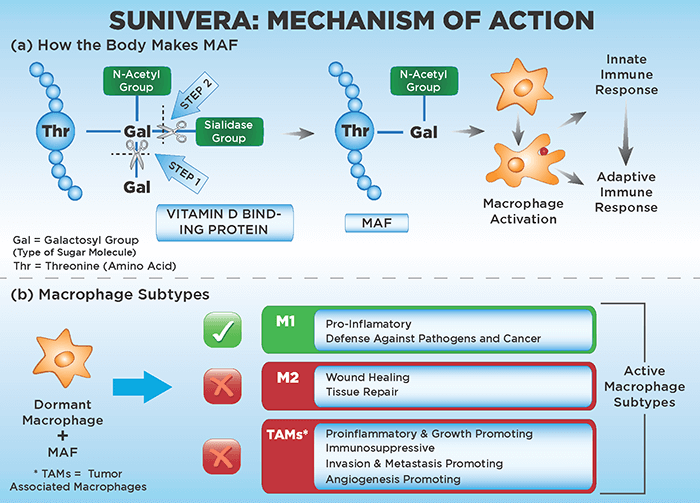
Figure 1. Mechanism of Action of MAF in the Body. Macrophages exist in a variety of forms, and in the absence of pathogens or cancer cells, can lie dormant awaiting an activating stimulus. Once activated, macrophages become capable of consuming and breaking down the invading cells (Figure 2). However, a deficient activating mechanism can result in macrophages either lying dormant or getting subverted by the cancer in the tumor microenvironment.2-3
![[Sunivera Immunotherapy] The role of macrophages in eliminating cancer cells, pathogens, and cellular debris](https://hope4cancer.com/wp-content/uploads/2025/08/Macrophage-MOA.png "[Sunivera Immunotherapy] The role of macrophages in eliminating cancer cells, pathogens, and cellular debris")
Figure 2. The role of macrophages in eliminating cancer cells, pathogens, and cellular debris.
However, more recent understanding of the complex mechanisms behind macrophage activation have shown that the nagalase model is too simplistic. While not fully understood, laboratory evidence has shown that MAF activates macrophages productively to attack pathogens and cancer cells, while having a positive impact on autoimmune conditions as well.
Next Generation Injectable and Oral MAF
In 2008, researchers reported that the administration of MAF resulted in regression of tumors and long-term benefits for cancer patients.4 Researchers at the University of Tokushima in Japan have now developed a patented process for the world’s most advanced injectable MAF, 15 times more potent than the first generation product. After treatment of over 1000 patients, the researchers have found the product safe and effective against a variety of cancers.5-8
Colostrum MAF, an oral version of MAF is also available9 – both the injectable and oral forms cross the blood-brain barrier.
The latest oral and injectable forms of MAF are available at Hope4Cancer Treatment Centers as part of the Sunivera Protocol.
How Does Sunivera Differ from Existing Immunotherapies?
As an endogenous bioidentical molecule, MAF has a very big advantage over currently available immunotherapies.10 Besides less expense and ease of administration, it does not cause serious side effects through the over-stimulation of the immune system (PD1/PD-L1 immune checkpoint inhibitors) or introduction of genetically-altered immune system cells (adoptive T cell transfer). It is significant to note that adoptive T cell transfer requires first that the patient go through “immunotransplant,” which essentially first involves killing off the patient’s immune system with chemotherapy or radiation.11-12
Synergistic Combination of Sunivera™ With Other Therapies
Clinical experience in Japan has shown that the benefits of MAF can be enhanced when used in combination with other non-toxic cancer approaches.5 Sunivera™ Bio-Immunotherapy Protocol represents the optimal integration of MAF with Hope4Cancer’s synergistic therapies and nutraceuticals that modulate both the innate (macrophages) and adaptive (NK cells and T cells) immune response. In combination with treatments such as Sono-Photo Dynamic Therapy,4 Sunivera favorably alters the tumor microenvironment13 to a healthier state. This sets the patient on a steady path towards disease resolution and improved quality of life consistent with our 7 Key Principles of Cancer Therapy.
Disclaimer: Hope4Cancer treats cancer patients with MAF only at its Mexico treatment centers; the product is not available for purchase outside the borders of Mexico.
References:
- Yamamoto, N.; Kumashiro, R. J. Immunol. 1993, 151 (5), 2794-2802.
- Noy, R.; Pollard, J. W. Immunity 2014, 41, 49-61.
- Sumiya, Y. U.; Inoue, T.; Ishikawa, M.; Inui, T.; Kuchiike, D.; Kubo, K.; Uto, Y.; Nishikata, T. Anticancer Res. 2016, 36 (7), 3619-23.
- Yamamoto, N.; Suyama, H.; Yamamoto, N. Trans. Oncol. 2008, 1 (2), 65-72.
- Inui, T.; Amitani, H.; Kubo, K.; Kuchiike, D.; Uto, Y.; Nishikata, T.; Mette, M. Anticancer Res. 2016, 36 (7), 3767-70.
- Inui, T.; Katsuura, G.; Kubo, K.; Kuchiike, D.; Chenery, L.; Uto, Y.; Nishikata, T.; Mette, M. Anticancer Res. 2016, 36 (7), 3771-4.
- Inui, T.; Kuchiike, D.; Kubo, K.; Mette, M.; Uto, Y.; Hori, H.; Sakamoto, N. Anticancer Res. 2013, 33 (7), 2917-9.
- Inui, T.; Makita, K.; Miura, H.; Matsuda, A.; Kuchiike, D.; Kubo, K.; Mette, M.; Uto, Y.; Nishikata, T.; Hori, H.; Sakamoto, N. Anticancer Res. 2014, 34 (8), 4589-93.
- Amitani, H.; Sloan, R. A.; Sameshima, N.; Yoneda, K.; Amitani, M.; Morinaga, A.; Uto, Y.; Inui, T.; Asakawa, A. Neuropsychiatry(London) 2017, 7 (2), 640-647.
- Akiyama, S.; Inui, T. Cancer Immune Therapy in Clinic: 2016. Clinics in Oncology 2016, 1, 1-3.
- Bollard, C. M.; Gottschalk, S.; Leen, A. M.; Weiss, H.; Straathof, K. C.; Carrum, G.; Khalil, M.; Wu, M. F.; Huls, M. H.; Chang, C. C.; Gresik, M. V.; Gee, A. P.; Brenner, M. K.; Rooney, C. M.; Heslop, H. E. Blood 2007, 110 (8), 2838-45.
- Dudley, M. E.; Wunderlich, J. R.; Yang, J. C.; Sherry, R. M.; Topalian, S. L.; Restifo, N. P.; Royal, R. E.; Kammula, U.; White, D. E.; Mavroukakis, S. A.; Rogers, L. J.; Gracia, G. J.; Jones, S. A.; Mangiameli, D. P.; Pelletier, M. M.; Gea-Banacloche, J.; Robinson, M. R.; Berman, D. M.; Filie, A. C.; Abati, A.; Rosenberg, S. A. J Clin. Oncol. 2005, 23 (10), 2346-57.
- Brown, J. M.; Recht, L.; Strober, S. Clin. Cancer Res. 2017, 23 (13), 3241-3250.
Learn About Other
Treatment Options
Harnessing the power of matter and energy, we utilize light and sound wavelengths to trigger biochemical reactions, effectively targeting cancer cells and activating the body’s immune response.
Discover innovative strategies designed to restore the immune system, helping to regulate abnormal cellular behavior and reverse the progression of disease.
Thermal energy is a powerful tool in the fight against cancer, as turning up the body’s thermostat has the potential to destabilize cancer cells and disrupt their growth.
We deliver high doses of specialized nutrients intravenously to achieve desirable biological responses. Anticancer activity, immune modulation, and nutrient replenishment are just a few benefits.
Explore therapies designed to slow down and reverse a dysfunctional state, disrupting the growth of cancer at its core.
Discover the link between cancer and cellular oxygen levels and how oxygen therapies offer a promising approach to combating cancer and pathogenic states.
Address the presence of disease-causing triggers in tumors with these therapies that help restore a healthy microbiome.
Explore innovative therapies that target the blood vessels created by tumors, disrupting their nutrient supply.
Inflammation is a hallmark of cancer and other chronic diseases, which is why we rely on these therapies to reduce abnormal and chronic inflammation.
Nourishing food has the power to fuel the body and is instrumental in providing vitamins, minerals, and antioxidants, all vital to the healing process.
Understand how electrical differences in cells affect their function and energy levels, and discover how we utilize these therapies in the fight against cancer.
In a world inundated with toxins, toxic buildup inevitably occurs over time, altering the body’s ability to repair itself. In turn, this affects quality of life and contributes to the onset of chronic diseases including cancer. Our detoxification methods are designed to enhance recovery by restoring the body to a functional state.
Moving the body can accelerate recovery, mitigate side effects, and reduce the risk of recurrence. We help our patients develop a personalized plan of exercise to handle physical stress, focusing on low-impact, high-return options.
Using individualized therapies, group sessions, and social bonding experiences, we help you learn the process of restoring your emotional and spiritual state to a health-restoring one.